The Break
Indonesia is the surfer’s holy grail — and Uluwatu is where it started
Spread across more than 17,000 islands, Indonesia holds one of the densest concentrations of world-class waves anywhere on earth — warm water year-round, an almost endless run of reef and point breaks, and a swell window that rarely goes flat for long. Bali is where most surfers meet this country for the first time, and the Bukit Peninsula, with Uluwatu at its tip, is where Bali earned its reputation.
Why Indonesia
Indonesia sits directly in the path of consistent south-Indian Ocean swell, and its coastlines are lined with the coral reef and volcanic point setups that turn open-ocean swell into the long, clean walls surfers travel across the world for. Water temperatures hold around 27–29°C (80–84°F) year-round, so there’s rarely a wetsuit in sight. The dry season, roughly April to October, brings the most consistent offshore winds and the biggest swells to Bali’s west-facing coast — Uluwatu included.
Beyond Bali, Indonesia’s reputation is built on places like the Mentawai Islands off Sumatra — widely considered to have some of the most perfect waves on earth, including Macaronis and Lance’s Right — and G-Land on the eastern tip of Java, a left point break famous for some of the longest barrels in the sport. Bali remains the easiest of all of them to reach, and the only one where a world-class wave is a short walk from where you’re staying.
The Bukit Peninsula
The Bukit — the dry, cliff-lined limb of land hanging off Bali’s south coast — hosts one of the tightest clusters of quality reef breaks anywhere in Indonesia, all within a short drive of Villaggio.
Uluwatu
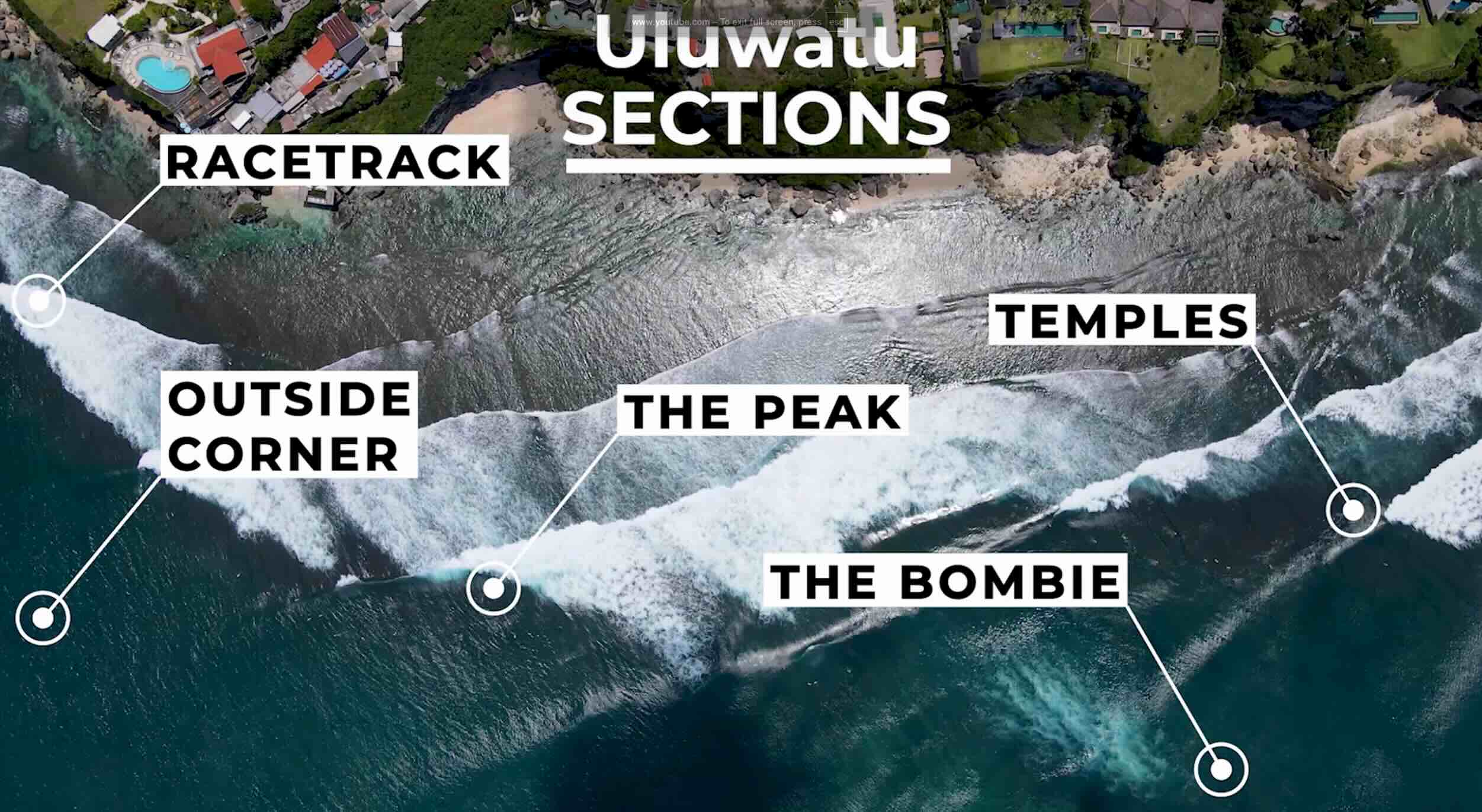
A long, powerful left reef break made up of several sections — Racetracks, the Peak, Temples, Outside Corner, and Bombie — that come alive at different tides and swell sizes. Ten minutes' walk from Villaggio.
Padang Padang
One of the best left-hand barrels on the planet when it's on, just around the point from Uluwatu — small, shallow, and unforgiving, and home to the Rip Curl Cup every year.
Impossibles
A fast, hollow left reef break next door to Padang Padang, offering a similar wave with a little more room to breathe.
Bingin & Dreamland
Two more Bukit Peninsula reef breaks within easy reach, each with their own character — Bingin a punchy, barreling left; Dreamland a beach break that's more forgiving for less experienced surfers.
The five sections of Uluwatu
Uluwatu isn’t one wave — it’s a chain of five named breaks along the same reef, each with its own character, each working best at a different tide and swell size.
The Peak
Directly out front of the cave where surfers paddle out — the most consistent section of the whole break, with shifty peaks that pick up plenty of swell and offer a rippable shoulder, up to double overhead on a good day.
Racetrack
An ultra-fast reef grinder that turns into a twisting, multi-section barrel as the tide drops — especially on the lowest tides of the month. Experts and professionals only.
Temples
Left-handed, less crowded, and the most varied of the sections — thick, heavy double-up barrels when it's on, alongside long, rippable performance walls that can run up to 100 meters.
Outside Corner
One of the most famous breaks in all of Bali — a third, outer peak peeling left off the cliffs, clearly visible (and closely watched) from the clifftop warungs above.
The Bombie
Indonesia's biggest wave on its day, holding swell up to 40 feet — one of very few big-wave spots on earth that matches it for size, power, and length of ride. Expert and pro surfers only.
Reading the reef
Nearly every wave on the Bukit breaks over shallow coral reef, not sand — which is exactly what makes them so long and so clean, and exactly why tide matters more here than almost anywhere else surfers travel to. Most of these breaks want a mid-to-high tide to cover the reef safely; low tide can expose coral entirely at spots like Uluwatu, where the paddle out becomes a walk across dry rock until the water comes back in.
None of that dulls the appeal. It’s the same reef setup that gives these waves their shape — long walls, rifling barrels, and a level of consistency that keeps surfers returning to this stretch of coastline year after year.